NQ and MNQ: what a tick and a point are worth
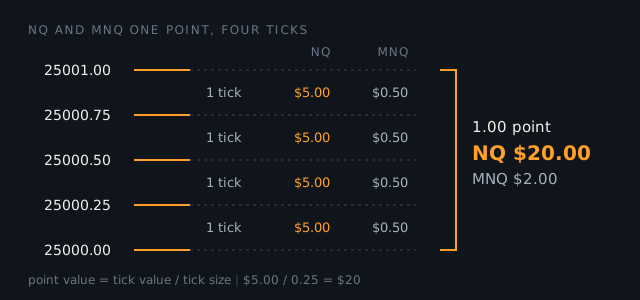
NQ, the E-mini Nasdaq-100, moves in ticks of 0.25 index points, and each tick is worth $5.00. MNQ, its micro, moves in the same 0.25 ticks, worth $0.50. Four ticks make a point, so a point is $20 on NQ and $2 on MNQ. They are the only two contracts Marc trades, so this page keeps to them, with the conversions you need in the middle of a session.
The two contracts
| Symbol | Contract | Size | Tick size | Tick value | Ticks per point | Point value |
|---|---|---|---|---|---|---|
NQ | E-mini Nasdaq-100 | $20 × the index | 0.25 | $5.00 | 4 | $20 |
MNQ | Micro E-mini Nasdaq-100 | $2 × the index | 0.25 | $0.50 | 4 | $2 |
The size is where everything else comes from. NQ is $20 for every point the Nasdaq-100 moves, so a quarter of a point, one tick, is $5.00. MNQ is $2 a point, so its tick is $0.50. Same ticks, a tenth of the money, which is why ten MNQ move exactly as many dollars per point as one NQ.
Points to ticks to dollars
For one contract, before commissions and fees. Two contracts move twice the dollars.
| Move in points | Ticks | One NQ | One MNQ |
|---|---|---|---|
| 1 | 4 | $20 | $2 |
| 5 | 20 | $100 | $10 |
| 10 | 40 | $200 | $20 |
| 15 | 60 | $300 | $30 |
| 20 | 80 | $400 | $40 |
| 25 | 100 | $500 | $50 |
| 40 | 160 | $800 | $80 |
| 50 | 200 | $1,000 | $100 |
| 100 | 400 | $2,000 | $200 |
Any other move is one multiplication: points × $20 on NQ, points × $2 on MNQ. Starting from ticks, it is ticks × $5.00 or ticks × $0.50.
Say ticks or points, never just the number. On NQ, a 20 tick stop is 5 points and $100. A 20 point stop is 80 ticks and $400. On MNQ the same two stops are $10 and $40. One word apart, four times the risk.
Quick answers
How much is one point on NQ?
$20 for one contract: four ticks of $5.00.
How much is one point on MNQ?
$2 for one contract: four ticks of $0.50.
How many ticks are in a point on NQ and MNQ?
Four on both. They tick in quarters of an index point, so 25000.00 to 25001.00 is four ticks.
How many ticks is 20 points on NQ?
80 ticks. On one NQ that is $400, and on one MNQ it is $40.
How many MNQ make one NQ?
Ten, in dollars per point: ten MNQ at $2 a point move $20 a point, the same as one NQ. They are still ten contracts, though, and commissions and exchange fees are charged per contract, so check what ten cost at your broker before treating them as the same trade.
Does the tick value change with the price, or the month?
No. It is fixed by the contract: $5.00 a tick on NQ and $0.50 on MNQ whether the index is at 15,000 or 30,000, and in every contract month. What changes with the price is how many points a typical move covers, not what each point is worth.
Sizing with the micro
The sizing arithmetic is the same on both, with the point value swapped in:
contracts = risk budget ÷ (stop in points × point value)
Say the budget is $200 and the stop is 10 points. On NQ, 10 points is $200 a contract, so the budget covers one. On MNQ it is $20 a contract, so the same budget covers ten. Make the stop 15 points and NQ no longer fits at all ($300 a contract), while MNQ still sizes to six ($180).
That is the real use of the micro: it sizes NQ exposure in tenths, where the full contract is all or nothing. The sizing guide covers what to put in the budget when the limit is a drawdown rather than a balance.
Sources checked
- CME Group, E-mini Nasdaq-100 contract specifications: a contract unit of $20 × the Nasdaq-100 Index, a minimum fluctuation of 0.25 index points = $5.00, and the product code NQ.
- CME Group, Micro E-mini Nasdaq-100 contract specifications: a contract unit of $2 × the Nasdaq-100 Index, a minimum fluctuation of 0.25 index points = $0.50, and the product code MNQ.
Related guides
What a tick is actually worth
Tick size, tick value and point value for twelve CME contracts, and why the same tick size can be worth different money.
Position sizing against a drawdown limit
On an evaluation account the balance is not what ends you. A floor is, and it sits closer than the balance suggests.