Position sizing against a drawdown limit
Almost every sizing rule you will read is written against the account balance. On an evaluation or funded account the balance is not what ends you. A floor does, and it is usually much closer than the balance suggests.
The sizing formula itself
Sizing is one division. Everything else is deciding what to put on top:
contracts = risk budget ÷ (stop in ticks × tick value)
Say the budget is $300 and the stop is 10 ticks on ES. A tick on ES is $12.50, so the stop is $125 per contract, and $300 ÷ $125 is 2.4 contracts.
You cannot trade 2.4 contracts. What you do about that is the first place risk leaks.
Rounding up is a bigger decision than it looks. Taking 3 contracts instead of 2.4 risks $375 against a $300 budget. That is a 25% overrun on every trade you round, and it adds up silently: the losing streak that was sized to cost you $1,500 costs $1,875 instead. Rounding down to 2 is the version that keeps the number you chose meaning something.
Static and trailing floors are different problems
Drawdown rules vary between firms and between account types at the same firm, so read your own account's terms rather than assuming. Broadly they fall into two shapes:
| Shape | How the floor behaves | What it punishes |
|---|---|---|
| Static | Set once at the start and does not move. Profit increases the distance between you and it. | Early losses. Once you are ahead, the floor is genuinely further away, and it stays there. |
| Trailing | Follows your high water mark up, and does not come back down. Some firms trail on closed balance at end of day, some on unrealised equity intraday. | Giving back an open profit. An intraday spike you never closed can drag the floor up behind you and leave less room than you started with. |
The intraday trailing version is the one that surprises people. If the floor follows unrealised equity, then being up $800 and closing flat is not a neutral day. It can leave you with $800 less room than you woke up with.
Size against the room, not the balance
The number that decides whether you survive is not the balance. It is:
room = current equity − the floor
Take a $50,000 account with the floor at $47,500. The room is $2,500. Risking a conventional 1% of balance is $500 a trade, which is 20% of the room. Five losing trades in a row and the account is gone.
Five in a row is not exotic. At a 50% loss rate any particular block of five trades has a 1 in 32 chance of being five losses, and waiting for the first such run takes around 62 trades on average. Those are two different numbers and both are ordinary. A few weeks of trading is enough to meet one.
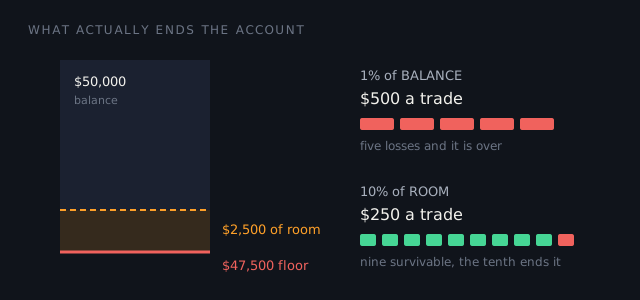
Sized against the room instead, the same account looks different:
- 10% of room is $250 a trade. Nine full losses leave $250 of room; the tenth reaches the floor, and that is before fees and slippage.
- 5% of room is $125, so nineteen survivable and the twentieth ends it.
- At $125 with a 10 tick ES stop, that is exactly 1 contract. With micros it is 10 MES, which is where the tenth-sized contracts stop being a beginner's instrument and start being the only way to express this at all.
This is arithmetic, not a promise. Sizing decides how long you last while you find out whether you have an edge. It cannot create one. A negative expectancy sized carefully is still a negative expectancy, it simply takes longer to arrive.
The stop has to come first
Notice what the formula demands: a stop distance, before a contract count. Sizing cannot be done in the other order, and the common failure is to pick the contracts first, from habit or from what the account allows, and then find a stop that fits them.
That inverts the whole thing. The stop then gets set by what you can afford to be wrong by rather than by where the trade is actually invalid, which is how a stop ends up two ticks beyond the noise and gets taken out on the way to being right.
Then what
Two calculators do this arithmetic, including the rounding overrun and the odds of hitting your floor at a given risk level:
Sources checked
Deliberately none, and that is the point of this page. Every other guide here ends with a link to CME or to NinjaTrader because there is a published specification to check it against. Drawdown rules have no equivalent: they are set per firm and often per account type within a firm, they change, and any single firm's page cited here would read as a general rule when it is not one. The arithmetic above is arithmetic, and it holds whatever your floor is. The floor itself comes from one place only, which is your own account agreement.
Related guides
What a tick is actually worth
Tick size, tick value and point value are three numbers people use as one. Each of them, for twelve contracts.
Order types, and why your stop did not fill
What market, limit, stop and stop limit each guarantee, and the one of them that can leave you holding a losing trade.