What a tick is actually worth
Tick size, tick value and point value are three different numbers, and most of the confusion in futures position sizing comes from using one where another belongs. Here is each of them, the division that connects them, and the figures for twelve contracts.
Three numbers, not one
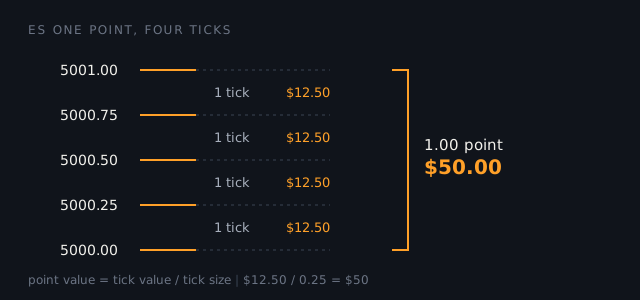
- Tick size is the smallest amount the price is allowed to move. On ES that is 0.25 of an index point. Price can go from 5000.00 to 5000.25, and never to 5000.10.
- Tick value is what one tick is worth in dollars, for one contract. On ES that is $12.50.
- Point value is what a full 1.00 move in price is worth. On ES that is $50.
You only ever need to remember two of them, because the third falls out of a division:
point value = tick value ÷ tick size
ES: $12.50 ÷ 0.25 = $50 a point. Crude: $10.00 ÷ 0.01 = $1,000 a point. That is also why our calculator stores tick size and tick value only, and derives the rest. A number you store twice is a number that can disagree with itself.
The figures, per contract
CME equity index, energy and metals, which is most of what this audience trades.
| Symbol | Contract | Tick size | Tick value | Ticks per point | Point value |
|---|---|---|---|---|---|
ES | E-mini S&P 500 | 0.25 | $12.50 | 4 | $50 |
MES | Micro E-mini S&P 500 | 0.25 | $1.25 | 4 | $5 |
NQ | E-mini Nasdaq-100 | 0.25 | $5.00 | 4 | $20 |
MNQ | Micro E-mini Nasdaq-100 | 0.25 | $0.50 | 4 | $2 |
YM | E-mini Dow | 1.00 | $5.00 | 1 | $5 |
MYM | Micro E-mini Dow | 1.00 | $0.50 | 1 | $0.50 |
RTY | E-mini Russell 2000 | 0.10 | $5.00 | 10 | $50 |
M2K | Micro E-mini Russell 2000 | 0.10 | $0.50 | 10 | $5 |
CL | Crude Oil | 0.01 | $10.00 | 100 | $1,000 |
MCL | Micro Crude Oil | 0.01 | $1.00 | 100 | $100 |
GC | Gold | 0.10 | $10.00 | 10 | $100 |
MGC | Micro Gold | 0.10 | $1.00 | 10 | $10 |
Quick answers
How much is one point on ES, and on MES?
$50 on ES: four ticks of $12.50. MES is a tenth of that, $5 a point and $1.25 a tick.
How much is one point on NQ, and on MNQ?
$20 on NQ: four ticks of $5.00. MNQ is $2 a point and $0.50 a tick. Those two have a page of their own, with every common move from points to ticks to dollars.
How many ticks are in a point?
Four on ES, NQ and their micros, which tick in quarters. One on YM and MYM, which tick in whole points. Ten on RTY, M2K, GC and MGC. A hundred on CL and MCL.
How many ticks is 20 points on NQ?
80 ticks. On one NQ contract that is $400, and on one MNQ it is $40.
How many ticks is 60 points on YM?
60 ticks, because a tick and a point are the same size on the Dow. On one YM contract that is $300, and on one MYM it is $30.
Every micro is exactly one tenth
Across all six pairs above, the micro has the same tick size as its full-size sibling and exactly one tenth the tick value. MES ticks in the same 0.25 increments as ES and is worth $1.25 instead of $12.50.
That is more useful than it sounds. On the economics, a micro is a tenth-sized exposure dial rather than a different instrument: a setup you would take with 1 ES can be taken with anywhere from 1 to 9 MES, which is the only way a small account sizes in something finer than all-or-nothing.
The economics are not the whole picture, though. Liquidity, spread and queue position are their own markets, and a micro will not always fill like a tenth of the full-size contract. Same arithmetic, not necessarily the same execution.
Points and ticks are the most expensive words to mix up. On NQ, a 20 tick stop is 5 points and $100. A 20 point stop is 80 ticks and $400. Same sentence, four times the risk. When somebody quotes a stop without saying which unit, it is worth asking.
Why the same tick size is worth different money
ES and NQ both move in 0.25 increments. A tick on ES is $12.50 and a tick on NQ is $5.00. So "I use a 10 tick stop" is not one risk setting, it is $125 on ES and $50 on NQ, per contract.
The same trap sits between RTY and GC: both tick in 0.10, and one is $5.00 a tick while the other is $10.00.
This matters most when you move between instruments and keep your habits. A stop distance that felt right for months on one contract is a different amount of money on the next one, and the account notices before you do.
Where this actually gets used
Two places, both arithmetic:
- Sizing. Contracts = risk budget ÷ (stop in ticks × tick value). Every term on the right is from this page.
- Reading your results. Converting a points-based journal into money, or checking that a platform's reported profit matches the move you thought you caught.
Sources checked
- CME Group, Micro E-mini S&P 500 contract specifications, confirms the $5 multiplier, the 0.25 index point tick and therefore $1.25 a tick, and by the same arithmetic the ES figures above.
- CME Group, E-mini Nasdaq-100 contract specifications, the $20 multiplier and the 0.25 index point tick behind NQ at $5.00, and MNQ at a tenth of it.
- CME Group, E-mini Dow contract specifications, the $5 multiplier and the 1 index point tick behind YM, and MYM at a tenth.
- CME Group, E-mini Russell 2000 contract specifications, the $50 multiplier and the 0.10 index point tick behind RTY, and M2K at a tenth.
- CME Group, WTI Light Sweet Crude Oil contract specifications, 1,000 barrels and a $0.01 tick, which is where CL at $10.00 a tick comes from, and MCL at a tenth.
- CME Group, Gold contract specifications, 100 troy ounces and a $0.10 tick, which is where GC at $10.00 a tick comes from, and MGC at a tenth.