Risk per trade: the stop, the contracts and the costs
Before you take a trade, you can work out most of what it will cost you if the stop is hit. Once you know the contract, three numbers decide it: how far away the stop is, how many contracts you hold, and what each contract pays in commission and fees. This guide works through each one on NQ, the E-mini Nasdaq-100 future, and MNQ, its micro, a tenth the size. They are the only two contracts we trade. Then the guide puts the three numbers in the order you would use them.
The planned loss
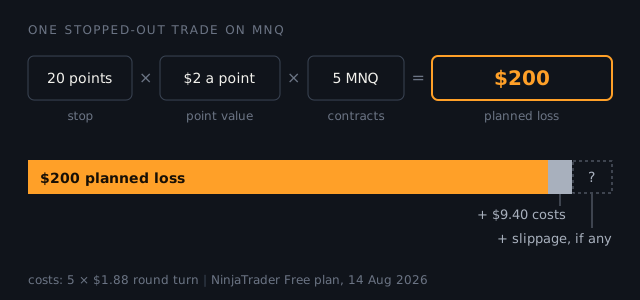
Your stop is the order that closes the trade if price moves against you past a level you choose, the stop price. The planned loss is what the trade loses if the stop fills exactly at that price. It is one multiplication:
planned loss = stop in points × point value × contracts
The point value is fixed by the contract: $20 on NQ and $2 on MNQ. So a 20 point stop is $40 on one MNQ and $400 on one NQ. If you measure your stops in ticks, a quarter of a point on both, divide by four first. The NQ and MNQ guide has the conversions.
Contracts multiply the loss
Each contract carries the whole stop. Three MNQ with a 20 point stop is three times $40, so $120. Ten MNQ move $20 a point between them, the same as one NQ, so ten MNQ and one NQ with the same stop have the same planned loss.
That makes the stop and the contracts two separate decisions. The stop goes where the trade idea is wrong, and the chart decides where that is. The number of contracts is what you change to make that stop fit your budget, the most you are prepared to lose on the trade.
Costs come on top, win or lose
Every contract pays a commission, a clearing fee, an exchange fee and a small National Futures Association (NFA) fee, once when you enter and again when you exit. In and out together is called a round turn. The costs are charged per contract whatever the trade does, so a trade stopped out at its planned loss loses the costs as well.
NinjaTrader, the trading platform, is also a broker, and it publishes all four together as one all-in rate per side, meaning per entry or per exit. Here they are doubled for a round turn, from its schedule dated 14 August 2026, still its latest when we checked on 29 October:
| NinjaTrader plan | One NQ, round turn | One MNQ, round turn |
|---|---|---|
| Free | $5.74 | $1.88 |
| Monthly | $5.14 | $1.68 |
| Lifetime | $4.34 | $1.28 |
The plans charge the same fees; only the commission differs. Monthly and Lifetime lower it in exchange for a platform fee: $99 a month, or $1,499 once. Another broker's figures will differ, so check its own all-in rate.
Small stops feel the costs most
The costs are a fixed amount per contract, so they weigh more against a small planned loss than a large one. On the Free plan figures:
| Trade | Planned loss | Round-turn costs | Share of the planned loss |
|---|---|---|---|
| One MNQ, 5 point stop | $10 | $1.88 | 18.8% |
| One MNQ, 20 point stop | $40 | $1.88 | 4.7% |
| One NQ, 20 point stop | $400 | $5.74 | 1.4% |
The same goes for the micros as a group. Ten MNQ move the same dollars per point as one NQ, but they pay ten sets of costs: $18.80 a round turn against $5.74.
Slippage: your stop price is a trigger
A stop market order becomes a market order once price passes your stop price, and a market order takes the best price available at that moment. In a fast market that can be a few ticks past the stop. Two ticks is $10 on one NQ and $1 on one MNQ. The order types guide explains why, and what the alternatives cost.
So a stopped-out trade costs the planned loss, plus the round-turn costs, plus any slippage. You know the first two before you enter.
Putting it in order
- Set the budget. The most you are prepared to lose on this trade, in dollars, with the costs included. This page does not tell you what that number should be.
- Place the stop where the idea is wrong, and measure it in points.
- Divide and round down. Budget ÷ (stop in points × point value), rounded down to whole contracts. If the answer is zero, no whole contract fits that budget with that stop.
- Add the costs. Multiply the round-turn cost by the number of contracts and add it to the planned loss. If the total is over the budget, take off one contract at a time until it fits. If even one contract does not fit, the answer is zero.
Say the budget is $250 and the stop is 20 points. On MNQ that is $40 a contract, and $250 ÷ $40 is 6.25, so six contracts and a $240 planned loss. Six round turns on the Free plan are $11.28, which takes the total to $251.28, just over, so one comes off. Five contracts is $200 plus $9.40, so $209.40. On NQ the same stop is $400 a contract, more than the whole budget, so the answer is zero.
Slippage is the one part you cannot add in advance, so a total that only just fits can still be overrun on a fast stop.
The position size calculator does step 3 for you. It works on price risk only, so step 4 stays with you.
One planned loss is 1R
Once a trade's planned loss is set, it makes a handy unit, called R. R measures price alone and leaves the costs out. A trade stopped out exactly at the stop price is −1R, and a fill past the stop makes it a little worse than −1R. The commission and fees are paid in dollars on top. A trade that makes twice its planned loss is +2R. Because each trade is measured against its own planned loss, R lets you compare trades of different sizes: with a 20 point stop, one MNQ stopped out is −1R and five MNQ stopped out is −1R too, though the five lose $200 to the one's $40.
Next: when the account has a floor
A prop firm lets you trade under its rules, first in an evaluation you must pass. Its accounts add a second limit to the budget: a floor the account has to stay above. The drawdown guide shows how to size against the room above that floor instead of the balance.
Sources checked
- CME Group, E-mini Nasdaq-100 contract specifications: a contract unit of $20 × the Nasdaq-100 Index, quoted in index points, and a minimum fluctuation of 0.25 index points = $5.00.
- CME Group, Micro E-mini Nasdaq-100 contract specifications: a contract unit of $2 × the Nasdaq-100 Index and a minimum fluctuation of 0.25 index points = $0.50.
- NinjaTrader, Futures Trading Commissions & Fees, as of 14 August 2026: for NQ, $1.39 exchange and NFA, $0.19 clearing and a commission of $1.29, $0.99 or $0.59, all in $2.87, $2.57 and $2.17 on the Free, Monthly and Lifetime plans. For MNQ, $0.36 exchange and NFA, $0.19 clearing and a commission of $0.39, $0.29 or $0.09, all in $0.94, $0.84 and $0.64.
- NinjaTrader, Pricing: commissions are "charged per side (per entry or exit), so a round trip is double the listed rate", exchange, clearing and NFA fees apply on top of them, and the plan fee is $0 on Free, $99 a month on Monthly and a one-time $1,499 on Lifetime.
- NinjaTrader 8 Help Guide, Order Types: once price passes the stop price, a stop market order becomes a market order.
Related guides
NQ and MNQ: what a tick and a point are worth
$5.00 and $0.50 a tick, $20 and $2 a point, and a points-to-dollars table.
Order types, and why your stop did not do what you expected
What each order type protects, what it leaves you exposed to, and what slippage costs per contract.
Position sizing against a drawdown limit
On an evaluation account the balance is not what ends you. A floor is, and it sits closer than the balance suggests.